
China’s end-mill sector is expanding with advanced machining demand, export competition, and tighter quality expectations. Grand View Research’s Cutting Tools Market Size, Share & Trends Analysis Report identifies Asia-Pacific as the leading regional market. Its findings reflect strong demand for carbide tools, automated production, and application-specific geometries. CMTDA industry statistics also show China’s continuing importance in global machine-tool manufacturing and consumption.
This guide examines China Top 10 End Mill Cutters for Drilling, with attention to measurable performance rather than attractive catalogs. An Endmill Cutter For Drilling must offer suitable center-cutting geometry, edge strength, chip evacuation, and controlled axial engagement. Not every end mill should plunge directly into solid material. That mistake can cause rubbing, deflection, heat buildup, or premature chipping.
Small details matter.
Tool diameter, helix angle, coating, coolant delivery, and workpiece hardness influence the result. For deep holes, helical interpolation may be safer than straight plunging. A pilot hole may also improve stability, although toolpath design remains critical.
Professor Tony Schmitz, a respected machining-dynamics researcher, emphasizes a practical principle: “Stable cutting must come before aggressive cutting.” That idea guides this comparison. Still, one limitation deserves attention. Supplier specifications do not always use identical testing conditions, so published tool life cannot be compared perfectly. Real workshops may see different results.
The following selection therefore considers geometry, material compatibility, runout control, drilling capability, manufacturer support, and practical value. It is not a blind ranking. It is a working reference for engineers, buyers, and machinists choosing end mills for demanding drilling-related operations.
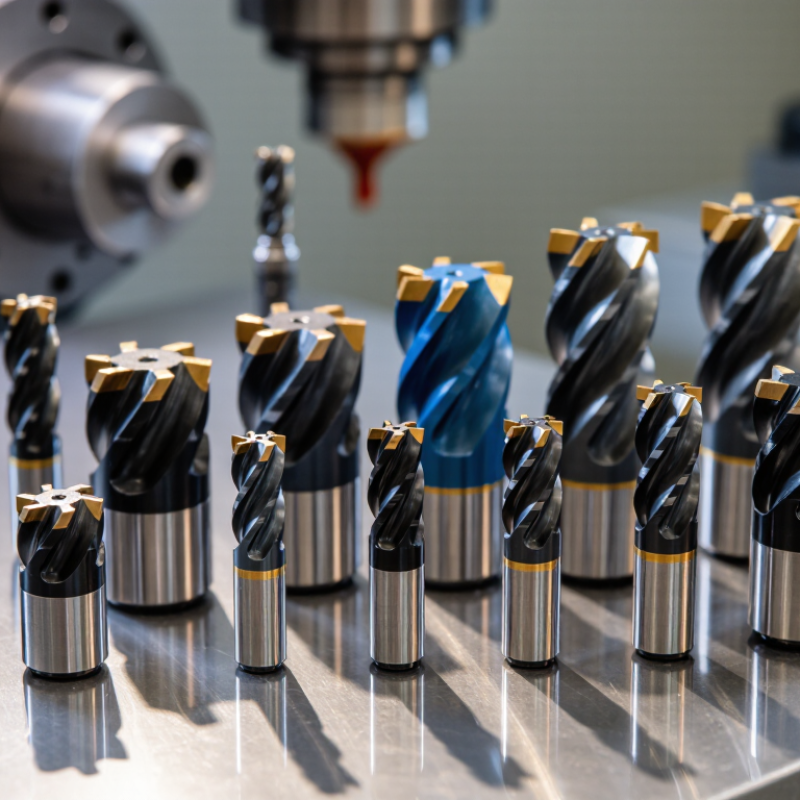
When comparing China’s top 10 end mill cutters for drilling, axial cutting limits deserve careful attention. An end mill is not automatically a drill. Its cutting center may be solid, open, or unsuitable for direct plunging.
A center-cutting end mill can enter material axially, but its performance depends on flute geometry, helix angle, diameter, and workpiece hardness. A 6 mm cutter may plunge slowly into aluminum, yet struggle in stainless steel without a pilot hole. Keep the feed conservative. Watch chip evacuation.
Drills usually manage axial loads more efficiently because their point geometry guides the tool into the workpiece. End mills often perform better with ramping, helical interpolation, or a pre-machined hole. This reduces rubbing and protects the cutting edges. I have seen tool failures caused by confusing radial capability with axial capability. It is an easy mistake.
ISO 13399 supports clearer tool data exchange. Useful fields include cutting diameter, flute length, overall length, corner radius, tool material, and cutting direction. These values improve comparison across suppliers, but they do not replace machining trials. ISO data describes the tool; it does not guarantee plunge stability, surface finish, or tool life.
Check the actual center-cutting specification. Confirm the recommended axial feed. Record spindle speed, coolant method, material, and hole depth. Small details matter. My own evaluation can still be incomplete when machine rigidity or chip packing is overlooked. Reliable selection combines standardized data with controlled shop-floor testing.
Only a center-cutting end mill can usually enter material axially. Check the center-cutting specification. A non-center-cutting tool may rub, deflect, or damage its edges.
Drill points guide axial entry more naturally. End mills often work better with ramping or helical interpolation. Direct plunging is not always suitable.
Two-flute tools evacuate chips quickly in aluminum. Four-flute tools offer stronger edges in steel. Variable-helix designs can reduce chatter.
A short, rigid end mill usually provides better stability. Corner-radius tools tolerate interrupted cuts more effectively. Micro tools suit tiny features but break easily.
It can describe cutting diameter, flute length, overall length, and corner radius. It may also identify tool material and cutting direction. Standardized data improves comparisons, but trials remain necessary.
Very important. Measure radial runout near the gauge line before machining. A practical precision target is about 0.01 millimeters or less. Poor runout can enlarge holes and increase heat.
Not necessarily. Excessive pressure may push chips deeper into the hole. Use steady flow near the flute entry. Through-tool coolant helps only when the equipment supports it.
Flute length alone does not determine the safe depth. Leave space for chip evacuation and prevent bottoming. Pecking cycles may reduce packing, but they can leave marks. My assessment may still miss machine rigidity or chip buildup.
Choosing an Endmill Cutter For Drilling requires understanding the fundamental difference between end mills and conventional drills. End mills are primarily designed for lateral cutting, so their axial cutting limits must be carefully evaluated before drilling operations. ISO 13399 tool data can support accurate comparison of dimensions and cutting characteristics. Key selection factors include diameter, flute count, helix angle, substrate, and coating, all matched to the workpiece material and hole requirements.
This guide presents ten representative Chinese end mill cutter options for drilling applications without focusing on brand names. It explains how feed rate, cutting speed, and tool life influence productivity and hole quality. Safety considerations are equally important, including minimizing tool runout, selecting suitable coolant pressure, controlling chip evacuation, and recognizing the limitations of blind-hole drilling. Proper parameter adjustment and stable machine setup can help reduce tool damage, improve dimensional accuracy, and achieve more reliable results.
